
Dispatch #50: On Summary
show and tell

Thanks for subscribing to Italics Mine, a newsletter about writing, reading, parenting, eating, putting on clothes, dancing, and various other delights (and challenges). If you enjoy this craft essay, please consider becoming a paid subscriber. Paying subscribers receive an email every Friday, as well as the occasional longer essay that I wouldn’t want to share widely…
This coming Friday, I’ll be offering paid subscribers a few writing exercises to practice summary writing. There, we can continue this discussion of scene and summary, and I’ll be offering writing advice to anyone who wants it.
Thanks for supporting my work.
For a long time, I was obsessed with writing scenes. I still am.
When a narrative is expertly dramatized, the words on the page transform into a kind of 3-D play of the mind. Immersed in a scene, one imbued with senses and sensations that are simultaneously emotional and physical, the reader is swept away, cast into rooms different from the one they’re sitting in. What a gift! What pleasure!
As I wrote in my previous craft essay, a scene is a completion of an action in a specific time and place. It’s the building block of fiction and narrative nonfiction, that “vivid and continuous dream” John Gardner’s always exhorting us to create.
Back when I was a baby writer, my teacher Ethan Canin instructed, “Put in scene what you want the reader to remember,” and I listened.
(I remember the room in when he pronounced this; I remember the long table at which we sat; I remember the other people in that room, taking notes or nodding or pursing their lips…)
The power of scene is creative writing 101, and I don’t disagree. Sometimes, however, the focus on scene-writing, on dramatization, on show-don’t-tell, leads us to neglect the other side of the writing coin.
If scene is the head of the coin, summary is the tail.
When I teach writing, I always cover both because you can’t have one without the other.
In his classic text, Narrative Time: Working with Imagination, Craft, and Form, Madison Smartt Bell writes: “Scene and summary are methods for treating time in fiction.”
At its heart, narrative is the depiction of time’s passage. It’s the writer who controls how, exactly, the reader experiences that passage.
To say it a different way: as writers, we manipulate time itself.
[Cue evil laughter; cut to image of woman—in a regrettable purple hat—bending the universe to her whims. Bwa ha ha ha…]

First, some definitions:
Summary is action and information that is told, rather than dramatized.
If a scene typically covers a relatively short amount of time, and takes a large amount of page-space to do so, summary covers a lot of time relatively quickly on the page.
A story requires not only the dilation of time, but also its compression.
It’s understandable why writing teachers emphasize scene writing. For one, most people, trained to avoid “making a scene” for their entire civilized lives, will shrink from this duty in their fiction, eliding the most interesting parts. Drama is scary! Or, new writers might painstakingly dramatize something dull…only to skip the compelling conversation or the juicy action. What we practice, as writers, is intuiting the sticky stuff—and going toward it.
The surest way to help a new writer draft a story is to ask them to choose four to six scenes. What would be the best scenes to show these characters in this interesting situation? Or, start smaller; start with one scene. Find a setting and make something happen there that will have consequences. Don’t forget to consider where the light’s coming from.
In her insightful craft book, The Hidden Machinery: Essays on Writing, Margot Livesey (another of my former writing teachers) reminds us that “many of the most revelatory and heartbreaking moments in fiction occur in scene.” And she’s right. For turning points, moments of crisis, and revelation of new information, scene is best.
But she also says that very few novels can be told entirely in scene. She continues: “When people in workshops shout, “Show don’t tell,” they are clamoring for the energy that dialogue brings, but that energy and drama comes in part from the contrast between telling and showing.”
The contrast—that’s what we’re after.
Summary has so many uses in storytelling!
First, it can alter the narrative register, usually to speed us up. It’s often used to move us from one dramatic moment to the next.
In Writing Fiction: A Guide to Narrative Craft, Janet Burroway taxonomizes two types of summary: sequential and circumstantial.
In the former, the summary moves us forward in a sequence. When you’re writing sequential summary, it’s useful to choose an organizing principle: Is it the changing seasons? Is it the college courses the character is taking? Is it the people she sleeps with, or the meals prepared and eaten? Whatever it is, how does the summary compress time to move us forward in a sequence? Furthermore, it’s important to recognize where (and when) you, ultimately, want to end.
Circumstantial summary, on the other hand, describes what things are like generally; in this kind of summary, time is not moving forward. The reason this part isn’t in scene is that nothing has changed—yet.
Consider the use of summary in Cynthia D’Aprix Sweeney’s wonderful and emotionally astute new novel, Lake Effect.
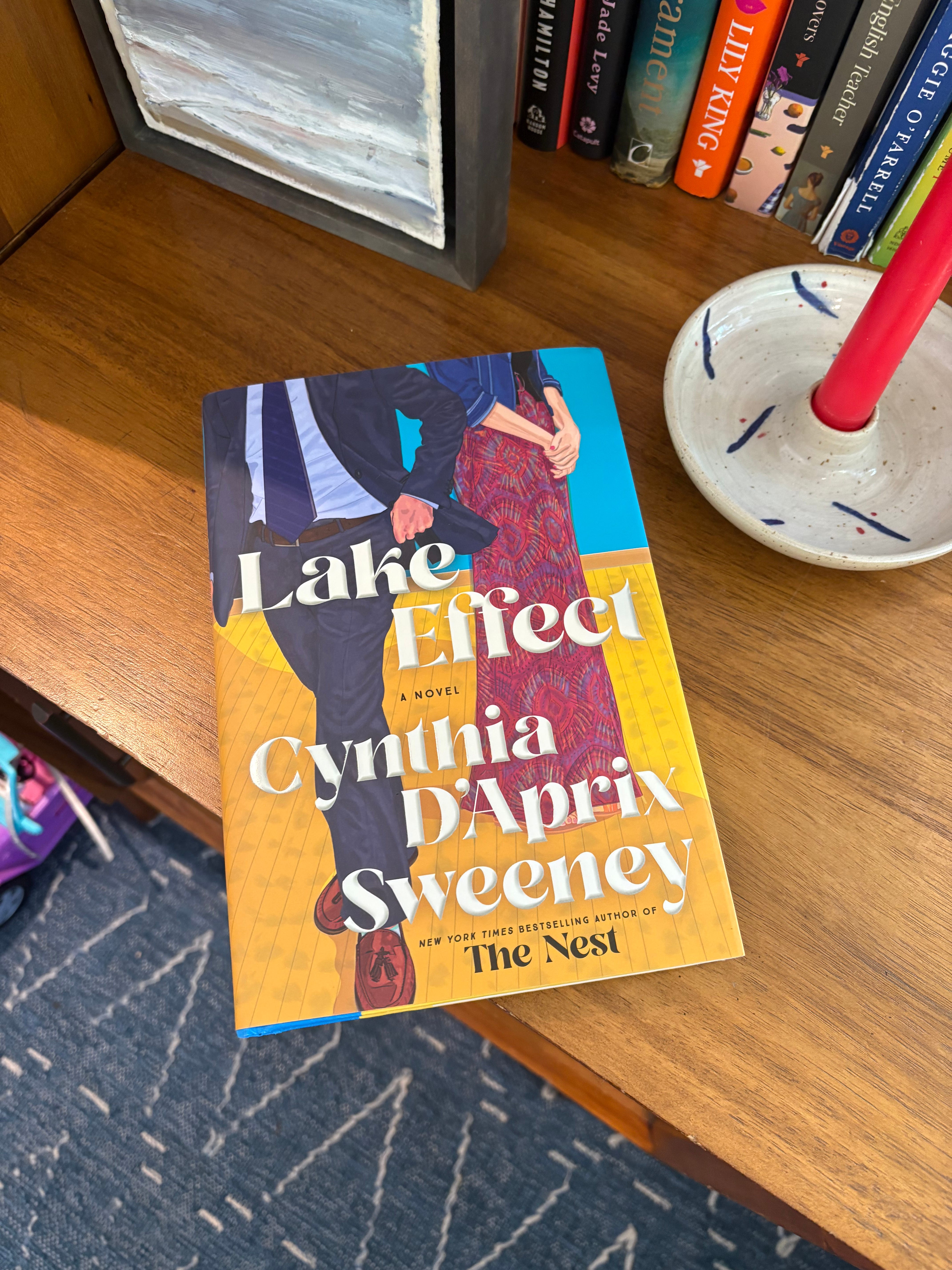
The following passage is the opening of chapter nine. It comes about forty pages into a 273 page book, and the shifting third-person perspective has turned to Honey, mother of Fern. Right before this, in the previous chapter, the point of view is with Fern, who has a stutter.
Here is how this new chapter begins:
Honey wasn’t unsympathetic. She hated the days when Fern came home from school visibly downcast and discouraged. She didn’t know if the Jesus prayer would work, but wasn’t it worth a try? Honey also believed, strongly, that if Fern could lose a little weight and feel confident in her appearance, the stuttering would improve. Wouldn’t it? Fern walked around like she was trying to conceal something; that kind of posture couldn’t help her esophagus. Larynx? If Fern felt comfortable in her body, prettier, if her school uniform hung nicely, all of it would make a difference.
Notice how the narrative doesn’t adhere to a singular moment of time. Days, plural, are mentioned. The use of conditional tense (“would”) implies a possible future— “her stuttering would improve”—that isn’t fixed.
And yet we feel held. We aren’t floating in space. How does Sweeney do it?
For one, the writing pins us with its highly particular and visual imagery. The line, “Fern walked around like she was trying to conceal something,” provides a unique visual that edges on the scenic. Summary gets a bad rap for being abstract, generic, but, in good fiction, it’s concrete and vivid.
The narrative is also lodged deeply inside Honey’s flawed perspective. That “Larynx?” line captures a singular moment of consciousness: for a second we exist in a pocket time, in Honey’s mind, before the summary picks up again.
Interestingly, the next passage in the chapter continues with summary, only this time, it’s sequential, revealing Honey’s history with Weight Watchers, from her first meeting:
“After Finn’s heart attack, he begrudgingly joined Weight Watchers and so did Honey to keep him accountable.”
To her recent ones:
“Now, when Honey led her own meetings, she always started by talking about confidence.”
The summary keeps moving time forward, and it’s specific and image-driven, providing scenic moments to keep it particular rather than abstract.
This chapter opening is also a reminder of how economically summary can provide exposition, another one of its uses. We do not need full-blown, dramatized flashbacks for every dang thing! Lake Effect reminds us to tuck past moments here and there in a larger swath of compressed time. Call them scenelettes or scene blips.
From this sequential summary, the chapter glides into a scene. At this point, the chapter has moved between many different moments in time, from Honey’s meetings, to when she was invited to lead these meetings, to moments of friction with Fern about her weight. It leads to this:
“It’s all she wanted for Fern—to become the best Fern possible. As she was running over in her head what the best possible Fern might look like, the real live Fern walked into the kitchen and made a beeline for the refrigerator.”
Here, the story is ready to pause, to unfurl, to luxuriate on a specific interaction for a longer period of time. The book intuits that this is the moment a scene is needed to show the characters interacting. And, by now, the reader has a trove of knowledge to interpret the scene.
If your summary is specific and sensory-driven, if it reveals information, if it’s as vivid as scene, then the reader is more than happy to swim through it.
Lake Effect moves between scene and summary with such facility and elegance. It’s also what accommodates its profundity. A book like Lake Effect, which spans decades in under 300 pages, and explores the ripple effects of an affair on two families, relies on sensual, scenic summary to move efficiently between characters and to swing ahead in time.
It also helps us see inside these characters more clearly. If Sweeney offered us only a scene between Fern and Honey where they argue about food choices, we wouldn’t have the same access to their vulnerabilities, histories, and flawed worldviews. We wouldn’t be so moved by the story.
In my own work, I’ve been thinking about how summary serves as a respite from the unrelenting pace of scenes, and how, too, summary is where characters get to negotiate meaning, wrestle with information, and just think. Summary is where character interiority gets the opportunity to stretch out. Summary is agile, it can alight from idea to idea, moment to moment, and this nimble quality captures—it mimics—consciousness. Isn’t that what differentiates narrative from other art forms?
Summary’s ability to place us in a character’s consciousness allows the narrative to explore and reveal its deeper subjects.
When we integrate scene and summary, when the narrative shuffles between these two different narrative valences, meaning gets made.
This kind of scenic, sensory, character-driven summary, and the narrative’s seamless interaction between summary and scene, the way one moves into the other, is what makes Lake Effect feel authentic.
It’s what makes it feel like a story, what keeps it from feeling like someone turned on a camera and walked away.
I’m guessing Sweeney didn’t overthink this summary-to-scene choreography. You can tell she reads a lot, and through that reading has learned to intuit the rhythms of storytelling.
It’s like she heard the music, and danced.
I’m dissecting these two narrative registers as if there are obvious boundaries. But, in most writing, scene and summary are not these discrete methods with defined borders. In fact, they often bleed into one another, and it can be tricky to differentiate between the two.
In some cases, summary might lead to a scene; in others, summary gets woven into the scene, and you move from one to the other, a web of experience, of time, a feeling of freedom.
It’s why reading feels so good—and why writing does too.
There’s nothing sexier and more powerful than the single sentence: “Five years passed.”
I mean—you can just make that happen!? In only three words?!
THAT’S HALF A DECADE!
And then, wow, you can transport readers to a single moment, with its unique light, its scents, its sounds, those words from that person. That feeling—
I am drunk on my sorcery!
Don’t you ever take these powers for granted.
The next time you’re writing, consider how you’re balancing these two narrative registers, summary and scene.
Hear the music…and dance.
Or, if you prefer the other metaphor: Flip the coin, then flip it again, so that your reader gets both sides.
Remember, if you’re a paying subscriber, I’ll be sending a newsletter with summary writing exercises this Friday.
If you don’t want to commit to a paid subscription, but you enjoyed this piece, you can always send me a tip! Honey I have a cappuccino addiction that needs your support. Thanks. xoxo
All of this is so helpful! I realized this week that my students didn’t really know what I was talking about when I said scene, (are they just reading less and less? Was I distracted and not bringing them along at the right pace? 😫) and there was a lack of explanation on any quick online resource. This breaks it down so perfectly. Thank you!
I love this! Thank you!